And to my own mother: I can only hope to be half the woman
you are. Everyone who knows you can attest to your strength and heart. I don’t
know how you can love so intensely, but I hope to learn. Thank you for raising
me with courage, and for letting me stretch your heart across an ocean. When I
was younger, I thought things changed between a kid and her mom once she became
an adult. I’m glad I was wrong. I guess that’s why that dumb children’s book
makes me so emotional these days. It’s true: “I’ll like you forever, I’ll love
you for always. As long as I’m living, my mommy you’ll be.”
Sunday, May 13, 2012
Mother's Day

Monday, April 30, 2012
Going to One Home and Coming Back to Another.
I sat in silence as the plane landed in Beijing, ultimately
aware that in a few moments, I’d be leaving the tarmac and seeing more ethnic
diversity than I had in nearly a year. Still, this knowledge wouldn’t prepare
me for the noise. As the familiar voices sputtering Mongolian drifted away from
each other, they were replaced by a cacophony of unintelligible noise. I zeroed
in on the high-frequency Chinese spoken by the workers directing passengers
through immigration, that is, until I heard English. I tried to keep from
staring as people who looked more or less like me were speaking a language I
could not ignore, masked in accents from England, Australia, somewhere Slavic.
It suddenly became a game to detect where these people had originated from. To
guess why they were here on this train heading towards baggage claim in the
Beijing airport.
Since last June, the only foreigners I had encountered were
expats roaming the capital or other fellow PCV’s. I stopped looking for them. I
forgot that when you are surrounded by people who look like you, no one notices
you. However, after my tour in the Beijing airport, I was back in the United
States, and I was invisible.
I arrived in Houston at nearly midnight and jogged to
baggage claim, fighting the urge to read every English sign I passed. The
previously abandoned carousel was soon after flooded with people. Everyone was
meeting someone. Though it was nearly midnight, I was giddy. Then I saw my mom
and brother from across the hall. In cinema-esque slow motion, we ran to
embrace.
“You smell like clean laundry!”
My bag finally dropped onto the carousel.
“Let’s go home.
I am wearing wool socks. It is so hot here.”
I’ve been asked what it was like to go back to America after
being away so long. The simplest answer is that everything has changed and
nothing has changed. I forgot about a lot of things that exist in the States:
Free refills. Self-checkout. Sales tax. Sweet, syrupy root beer. Traffic laws. Free condiments. Marketing campaigns.
Malls. Frozen yogurt. So many pillows on one bed. “Shotgun.” Canned biscuits.
Ice machines. Happy hour. Free samples. Radio. Icees. Right-of-way. And I also forgot some things that are customary to do in the States, like tipping waiters, or waving when
you cut someone off.
Overall, I was shocked at the excess. At times, it was
overwhelming to be in stores. There are
too many colors in here. Why are there so many signs? I don’t want this lotion
sample. I don’t need help. I don’t want to buy the one with 12 functions. Phones
were suddenly small computers that people used to log on to the internet to
send messages to one another to then be checked on the internet on a phone
instead of calling or texting.
America was loud. Advertisements were shouting at me.
Telling me what to buy, how to feel about myself. Pointless conversations being
held by teenagers behind me on an escalator could no longer be tuned out
because of a language barrier. I was inundated with English.
At the same time, I transitioned from the robotic English I
had begun to speak with my students quickly back to the fluency of a native
speaker. I could express my opinion eloquently and thoroughly. I could hold
intelligent conversations. I could argue. I could tell people what they meant
to me. English became so much more developed and useful. I found myself
speaking again with a southern drawl.
But after two weeks, I deeply missed Mongolia. I missed my
friends. I missed the simplicity. I couldn’t hide the smile on my face when
lining up again in Beijing to check into the last leg of my flight. I was
surrounded by Mongolians. I could understand them. I laughed as they tried to
check in 15 boxes marked “fragile,” wheeling them closer to the counter on an
unsturdy cart. As quickly as we dispersed from one another in Beijing two weeks
prior, we were back in the same line. Once again, I was surrounded by people
from the country I had grown to love. I find myself lucky to be able to call
two places home.
Tuesday, March 6, 2012
"This is a place where I don't feel alone. This is a place where I feel at home."
Everything in Mongolia can be bought individually.
Packages are broken and items are sold piece-by-piece.
I can buy a single sponge, one roll of toilet paper, one battery, one fork, one egg, one piece of gum.
And I do.
The ladies who run the store I frequent are aware that I live alone. That I look different than everyone in my town. That I buy two eggs, one pepper, three onions. I have no use for more.
But they also know my age. My phone number. Where I am from. Where I live and work. Where my closest American friends live. They know my opinions about the weather. My inability to dress properly for the winter. They suggest my favorite bag of boov, which I will not be able to finish by myself before it becomes rock hard. Because I live alone.
I moved here expecting to equate living alone with loneliness. But I cannot go outside without being noticed. This fact used to frustrate me. I thought back to the anonymity I possessed in the US. How I could go an entire day without speaking to anyone, even though everyone around me spoke the same language I did. Yet here, where I still struggle to be understood, I cannot cross the schoolyard without shouts of “Hello, Sara teacher.” Without kids running to hold my hand from gate to gate. I am greeted daily by faces and a language that were entirely unfamiliar to me 9 months ago. And in knowing this I realize: I am just as unfamiliar to them. But despite our differences, they still talk to me. Laugh with me. Open their homes to me.
I am here individually, but I am not alone.


Wednesday, February 29, 2012
Tsagaan Sar: The White Month
Tsagaan Sar is the celebration of the lunar new year on the Tibetan calendar. Since the dates are based on the moon and decided by monks, they change every year but usually fall sometime in February. This year, Tsagaan Sar Eve, or Bituun, fell on Tuesday, February 21st. For arguably one of the most important holidays of the year, I traveled back to Selenge to visit my host family.
 |
| Snowy, Frozen Orkhon River |
I arrived in Orkhon Tuesday night after leaving my home in Baganuur at around 8 a.m. I was thrilled to be back in the home I spent my amazing summer in and back with the family I grew to love. I realized just how much my language skills have advanced as we sat around the kitchen table sharing stories and catching up on the past 6 months we’ve spent apart. My brother came home from school in UB for the holiday, but unfortunately my sister couldn’t come back from Russia. Still, I got to talk to her on the phone which was really nice. Bituun is traditionally spent with your family as you eat the last meal of the old year, which coincidentally, will be the same meal you eat for about a week as you visit friends and family. The typical Tsagaan Sar table spread is impressive and quite ubiquitous, reminiscent of the way many families' Thanksgiving tables yield the same foods year after year. Since Tsagaan Sar means white month, most of the food you’ll find on the table is also white. Massive towers of boov (fried pastry bricks made by hand and stamped with traditional symbols) are erected and hold an even larger, round boov on top covered with an assortment of white treats. My family’s tower was topped with aruul (homemade dried yogurt curds), sugar cubes, and white candy-covered peanuts. A variety of “salads” will also be present, the most common being niiclel salad, which is a mayonnaise-based spin off of potato salad. Next to the tower of boov, some sort of boiled animal carcass will be proudly displayed. My family had a sheep with the fatty tail bit still attached. As guests arrive, hot plates of buuz will appear (steamed, meat-filled dumplings) and served with suutei tsai (milk tea). Next, shots of vodka will circulate, usually accompanied by either airag (fermented mare’s milk) or a Mongolian weak milk vodka.
 |
| Eej heating homemade wax |
 |
| Our Tsagaan Sar Spread |
 |
| Making candles |
So on Bituun, all of our food was already prepared and we sat down together to eat our traditional meal, before walking across the yard to Emee (our grandmother’s) house and celebrating again with her. The next morning, we went outside to greet the first sunrise of the new year. Then, our first meal was again with our family, and we exchanged the traditional holiday greetings with each other, starting with the oldest family member. My dad fetched his furry hat and sat down as each of us approached, placed our arms under his elbows (a sign of support and respect) and said the appropriate greetings: “Amar baina uu?” “Saihan shinelj baina uu?” A quick side-to-side sniff of the hair later, we greeted the next person. If you greet someone the same age as you are, (after an awkward moment where both of you try to put your arms on bottom) you each place one arm on top and the other on bottom. After our breakfast buuz, we went to Emee’s house and repeated the meal.
 |
| Uncle Otgoo, Emee, Me, Eej |
Visiting is a central part of this holiday. The first day is (more-or-less) reserved for visiting your closest family members, the second for more distant relatives, and the last for friends. However, this is all relative since some people will be traveling very far to share these visits, making this holiday drag on for weeks. Since my Emee is 86 and probably the oldest living person in my town, she had an incredible amount of visitors of the first day. My mom and I helped her host as best we could.
At each home you visit, there is an unstated rule that anything you take should be in three’s. Eat at least three buuz, drink at least three shots of vodka. If I don’t eat buuz until next Tsagaan Sar, it will be too soon. Families prepare literally thousands of buuz ahead of time and freeze them outside in anticipation of the hordes of visitors they will receive. Also, families must give at least more than one gift to each visitor, making this holiday a little like Christmas in terms of gift-exchange, and a little like Halloween in terms of how much candy you’re sure to consume. Also, everyone gets dressed up in their fanciest new traditional clothes, and men pass around their prized snuff bottles to each greeted guest (and with this exchange, another complicated greeting and hand-off). I received all sorts of gifts, even from people I barely knew, including money, chocolates, cookies, phone units, a notebook, pens, aruul, boov, keychains, pencil cases, chopsticks, a scarf, lacy underwear, and a glittery black satin handbag. I was overwhelmed by their generosity. Accepting these gifts did feel a little odd since it is not customary for the visitor to return the gift. The typical gift-giving reciprocity does not apply here, and that was a strange adjustment for me.
 |
| Visiting Tumee with fellow PCV's |
I stayed several days at my family’s house in Orkhon and was able to visit old friends and my Mongolian teacher from the summer. Then I went to the neighboring town, Khutul, to visit a fellow PCV’s family who were like a second family to my own this summer. However, I arrived before they returned from visiting family in Darkhan, an hour away, so I was taken in by their relatives whom I had never met. The ritualistic meal and visit ensued, and after just an hour and a half with this family, I was included in their family photo session and sent off with yet more gifts. Back at the apartment of my friend’s family, we caught up on each others lived over buuz, tea, and several very competitive games of khuzer (cards). The next day, my friend’s Eej made us tsuivan, a welcomed break from buuz, as we looked for a ride back home. His host brothers begged us to stay until Sunday, but not wanting to arrive home exhausted on Sunday before Monday’s lessons, we insisted that we had to leave Saturday. We finally found a ride and were forced to eat more buuz before we left. After several hugs and promises to visit in the summer, we set off for home in a meeker full of nine people and two babies. I turned around to wave goodbye as his mom flung milk from the apartment windows—a blessing upon our long journey.
 |
| Our Family Altar |
Indeed we had no idea how long our journey was about to become. From Khutul, we were only about 4 ½ hours from UB, but after two hours had passed, our meeker started smoking uncontrollably, and we stopped along the road and waited, miles from the nearest town. What we were waiting for, I wasn’t sure. An hour passed and the sun was quickly ducking behind the mountains. Just a few hours ago, I was cursing the heater for being on full blast, suffocating me in my deel. Now, the windows had begun to ice from the inside. After two hours on the side of the road, the driver got the engine to turn over and we headed back towards Khutul with plans to stop in the first soum we encountered. About 20 minutes later, we arrived in the dark at a small town on the river. We waited at a closed gas station inside our meeker. The sheets of ice on the window were thickening, and I was assessing the situation, wondering what would happen next. Armed with all my Tsagaan Sar gifts, I knew I wouldn’t be hungry. And I had my sleeping bag with me if worst came to worst. My friend and I joked about rationing our Choco Pies and half-liter of water as the babies in the car became restless from the imminent cold. Five hours had passed, and I could see my breath as we waited for help. The driver was outside attempting to flag down cars in hopes of finding extra room for his passengers to join them en route to the city, but he had no luck. Eventually a bus came, and two lucky and fast women from our meeker boarded it before it zoomed away. I feared this would be the last bus for the night. However, after a little more time passed, another arrived and the driver successfully got it to stop and pick up me and my friend. We boarded the packed bus and quickly defrosted, balancing atop the buckets that had been placed in the aisle for us to sit on. Two and a half hours later, we were in UB just shy of midnight, and luckily found a hostel with vacancy where we could stay before the rest of our journey.

My first Tsagaan Sar seemed to last an eternity, while at the same time, was a whirlwind of activity. Even today at school, the festivities continue and deel-wearing teachers greet each other in the traditional manner. During this blog post alone, I have had to get up 11 times to greet my elders. I’m happy to be a part of a culture that is so hospitable and generous, and I am reminded that especially during this holiday.
Monday, February 13, 2012
Цасний Баяр: Snow Happiness Day
It’s another winter Saturday—a day that has become synonymous with sleeping in and watching television online. An ocean doesn’t change much. I had just gotten around to loading the first of surely several episodes of “Lost” that I would watch on my day off, when I received a text from my counterpart, Enkhjargal.
“Will you go snow day? Please come with my family.”
“I’m sorry. I don’t know what that is. What time is snow day?”
“Just stay outside.”
Confused and assuming someone might show up to my apartment at any moment, I got dressed in what I considered warm clothes for an ambiguous “snow day.” Moments later, my manager, Sarnai, called me and told me to go outside and get in Enkhjargal’s family car.
 |
| My school's tent |
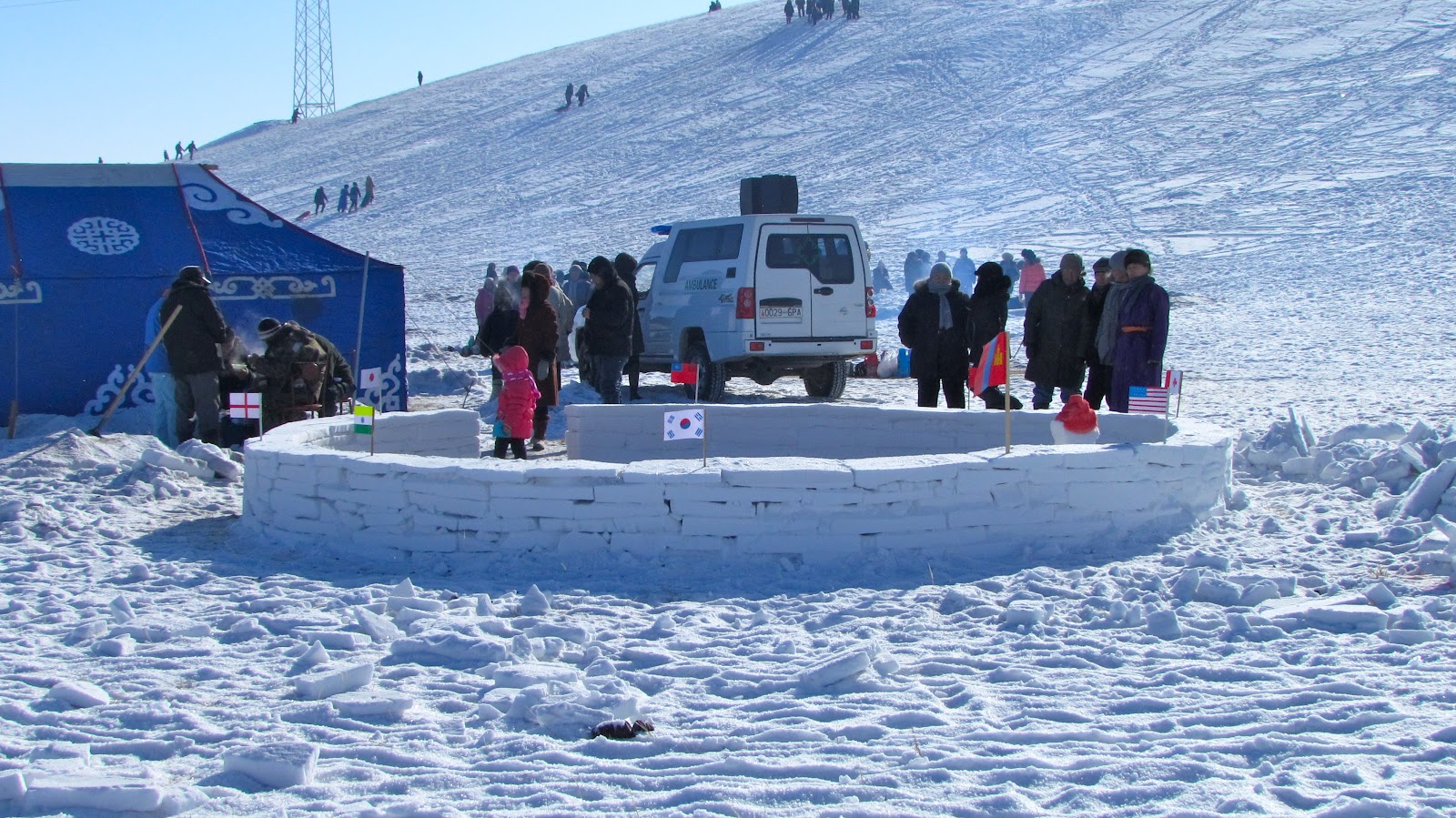
 Waiting in the car were Enkhjargal, her husband, her three daughters, and several thermoses of what I assumed was hot milk tea. We drove out past the limits of Baganuur, about 15 minutes from the main road. The mountains greeted us on both sides as we coasted along the white steppe. Then, seemingly out of nowhere, the glimmer of cars in the distance caught my eye. We turned off and took a snow path towards the idle row of machinery. Beyond the cars, more colors speckled the white snow. I saw the bright blue of tents being erected, smoke from fires rising, neon children dragging sleds. “Ah. Tsasnii Bayar.”
The celebration translates to “snow happiness.” Sarnai told me that they had chosen to celebrate snow day today because it wasn’t very cold. It was about -13 F, which is cold, yes, but a considerable improvement from -30 F. As I looked around, I realized that most organizations from our town came out to make an appearance. The banks, the hospital, the schools, the government workers—everyone had a tent somewhere to recognize this official leave-town-to-play-in-the-snow day. I approached my school’s tent and was swiftly redirected to the steppe with several teachers on a snow block harvesting mission. There was a London 2012 Olympics-themed snow sculpture-building contest that was beginning and we needed materials. We were out beyond the city. This snow had never been trampled. It was pristine, and it stretched out for miles until greeted by the base of the neighboring mountains. My feet floated above it with each step for a half-second—an astoundingly simple effect of the unbroken surface tension—before being engulfed to the ankles. I retrieved my feet, step-by-step, and carried on. When we reached the spot where the “good snow” was, we began to chop away at it, saving giant, compact blocks to carry back to the tent.

 |
| Competitions, of course |
 |
| My sitemate, Brian, and I |
 |
| Enkhjargal pouring suutei tsai |
Once at the bottom, I was considerably colder. I made it back to our tent where Enkhjargal gave me a bowl of hot aarts to drink. This thick, yogurt-like beverage is not my favorite, but it was warm and I was not, so I took it graciously. At this point, I wasn’t feeling very well. I’d been lightheaded most of the day, but had been ignoring it in order to have a good time at my first tsasnii bayar. Before long, my teachers began passing a lot of food around. Buuz, tsuivan, budaatai huurga, boov: all of the staples were there. I had a little and some milk tea to help warm me up. After lunch, my counterpart, Alta, dragged me back up the mountain to meet our friends, B. Saraa, Kh. Saraa, and Enkhtuya. Once at the top, I was winded and dizzy. After posing for a few pictures, I sat town to get my bearings while the girls wrestled in the snow. They were soon ready to walk back down, but I was too dizzy yet to trust in my ability to stand steady on the steep hill. “I’m going to rest. I don’t feel well,” I told them. So we waited a few minutes. Feeling slightly better, I was helped to my feet and we began out descent. After walking only a few feet down the slope, I felt immediately sick and fell down, unable to process exactly where I was. I started shivering from the cold that had permeated my shoes and gloves, removing all feeling but pain from my extremities. Two of my friends had run down the hill to get help, while Kh. Saraa stayed with me. I lied back on the snow and closed my eyes. Saraa told me that I looked white, that my blood was low. A couple minutes later, my friend Aagii lifted me up onto his back and carried me down to the base of the mountain, where I was quickly put into a warm car. They took off my gloves and gasped at the color of my hands, which was anything but natural. They tried to bend them out of their frozen state, but they were stiff and unyielding. I couldn’t grasp the bowl of hot tea that was handed to me, so instead, it was placed on top of my hands, and Zolzaya, who was sitting in the car next to me, wrapped her hands around mine, persuading them to thaw and bend.
 |
 |
| Saraa, Saraa, Enkhtuya, Alta |

I rode back to Baganuur with Enkhjargal’s family and Zolzaya, and my two counterparts helped me up to my apartment once we arrived. My boots were pried off, followed by the two pairs of socks I was wearing. My feet were blocks of ice, devoid of all color save for red splotches. I changed into warmer clothes, and my friends sat with me in bed as I thawed out. Regaining the feeling in my hands in feet was very painful. I was overcome by pins and needles. Enkhjargal filled a bottle with hot water and placed it at the foot of my bed, and while I know they hadn’t, I thought my feet had caught fire. I warmed up a while with the help of my friends and hot tea, and then they left me to rest. I have said this before, but I am so lucky to work with the people that I do who take such good care of me.
 |
| Tsasnii Ger! |
I was really bummed that I had to leave snow day early. I place the blame on the migraine medicine I took that morning which affects my blood pressure. But I’ve included pictures so hopefully you’ll see what a good day I was having despite the episode. I never had snow days to enjoy in Texas. I’m already looking forward to next year’s celebration.

Saturday, February 4, 2012
Teachers' Day
In addition to being my 8th month anniversary from leaving home, this Tuesday was Teachers’ Day here in Mongolia. Notorious for finding things to celebrate, my counterparts had been assuring me for weeks that for this party we would spare no expense (Jurassic Park, anyone?). The celebration began in the morning, when 11th graders taught the classes instead of the teachers, a method to whose efficacy I cannot accurately speak. It was all in good fun. Classes ended early at noon and I assume everyone went home to get fancy, something I was unaware of when I showed up at 2 to Baganuur’s Culture Center entirely underdressed (while probably wearing the nicest thing I own). I found a seat in the crowded auditorium and sat for hours as an awards ceremony progressed, accompanied by a looped Casio track—some amalgamation of “Pomp and Circumstance” and “Hail to the Chief.” They sure love their Casio. The Governor gave a speech, highlighting all the improvements his cabinet has made around town this term (clever man, since it’s an election year). I cheered for my teachers who were chosen to receive awards that they proudly wore the entire night. As aforementioned, awards are a big deal. After the ceremony had finished, various performers took the stage. Traditional Mongolian instruments were (unfortunately) paired in duet with the Casio that made an encore appearance. Ladies and gentlemen in fancy costumes sang really loudly, struggling to be heard over the Casio’s drumkit. Brass instruments (the first I’ve seen in Mongolia) even competed for a moment in the spotlight against the synth of the keys. Finally, all of that stopped and a man with a single murin khuur (horse head fiddle) came out and played a beautiful arrangement. Next, some students did a strange pop-and-lock dance to some sort of dub-step remix while wearing matching outfits and sunglasses. It was all very entertaining. Out of nowhere, the concert was over and teachers restlessly shuffled from the auditorium. “Bayariin mend” “Bayar khuurgii” Congratulations were awarded all around (the traditional greeting on holidays for the most part) and my friend, Alta, hooked her arm in mine while another buttoned my coat and escorted me to the door. “Now we leave.” “Where are we going?” “Party.”
It was 5 p.m. The awards ceremony was for the entire district, but my school’s party was not supposed to start until 7. I asked what we would do until then. My teachers said we would go somewhere and sit. We went to a bar/restaurant and had a beer (miraculously, a stout—Happy Teachers’ Day, indeed) and, strangely, a single boiled egg. After sitting around for a while, we left for the fancy restaurant where our party would be. Our department (foreign language) commandeered an entire corner of the room away from others, which was probably for the best since we can get rowdy. There was a band formed of miners (again, playing brass instruments). They played for a while and we sat around and talked and drank juice. This party, I was told, was going to be dry. That’s right. A Mongolian party without alcohol. None at all.
So we were sitting at our table, hanging out, when another awards ceremony started. Several of my teachers received awards. And then, my shining moment of glory: our volleyball team was called up to receive our winnings from the tournament held a few weeks earlier. Hand in hand, we ran forward cheering. Our stoic school director shook my hand and told me congratulations. We took a picture and carried our prize back to our table. And then it was over, and I was hungry. The food hadn’t come yet, so everyone decided to dance.
Dancing in Mongolia is a funny thing. First, it is not usually your choice to start. Second, you may only dance in one way: a circle. “Sara, you will dance now.” “No, I think I will sit here and drink this aloe juice. Mmm.” “No. Dance now.” So I was grabbed by the wrist and inserted into the circle. Knees were bending in rhythm to some Jennifer Lopez song, I’m sure. The circle dance: everyone moves the same, and everyone watches each other. If you’re lucky, you are under the bright, romantic fluorescent lights of a restaurant like we were. At about that time, one of our female gym teachers, Buya, dances up to me and puts her jacket around me, enticing me into a strange mirror dance. Thankful that the song ended, I sneak back to my seat.
Our food finally came. We had chicken. What a treat! While everyone was seated for dinner, gifts were given to the teachers who were given awards. They received a variety of presents: money, chocolates, vodka. Hello, loophole. So that is how our dry party became very vodka-infused, very fast. Bottle after bottle of Chingiss Gold was finished. We danced again. The shot glasses followed us to the dance floor (literally, glasses). We sang terrible English music really loudly. I pretended to know the words to Mongolian songs. When the chorus to “Zaya” came, I sang “Zaya, zaya, zaya” as loud as my counterparts did, arms resting on each other’s shoulders. “Forever, forever, forever” and we swayed back and forth. Buya came back and grabbed me, dragging me rather forcefully away from my friends who held on to me and yelled at her to stop and let me go. I felt protected. I taught my teachers to swing dance. Then I taught my manager. An 11th grader showed up to sing a Michael Buble love song as congratulations to his teacher who won an award. I was asked why I didn’t know the words to this English song.
The night was winding down. It must have been close to midnight and time to leave. I was looking around pathetically for full bottles of juice to take home. One of my teachers brought me an apple to put in my pocket, knowing they are expensive. We picked up our coats from the front room and headed into the cold. Arm in arm, we stumbled together through the streets, planning which teachers to take home first, gossiping along the way. My department was the last to leave. Alta and I, living in the same building, split from the group and took a shortcut through a park home. I got home about 12 hours after I had originally left for this Teachers’ Day Celebration. It was a lot of fun to take time to celebrate all the educators in my town. Special recognition was given to all of the great accomplishments made by those who have worked so hard, and I think that recognition for teachers can sometimes be overlooked. I am lucky to be living here in a culture that values and respects teachers so much.
I had a great first Mongolian Teachers’ Day, even though I forgot to bring my camera to document it. Tuesday was also a very special day in my life back home. My brother and his wife had their first son only about an hour before I had to leave for the awards ceremony. I got to Skype home to them while they were still at the hospital. I feel so blessed to have been able to be a part of such an important day. So here’s a picture of my brand new nephew! Isn't he perfect? Congratulations, y’all!
 |
| Carson Dean |
Thursday, February 2, 2012
Mongol Chuud Sportond Ikh Durtai
I grew up with a healthy dose of competitiveness. I was always in sports. I had two older brothers who never let me win. Like my Mongolian counterparts, if something is made into a competition, I am around 80% more likely to participate. Which is why I bundled up in layers of clothing, headed out in to -30 degree weather, and arrived at my school’s gym for what would be a seemingly never-ending sports-off.
My training manager told me the event would start at 9 am, adding “You are a foreigner and always on time. Please don’t come at 9.” The first game began at 11. As frustrating as it can be at times, I am growing accustomed to “Mongol Time:” life does not need to be rushed. There is nowhere you need to be so urgently that you should pass up what you might see on the journey. I think it’s a good lesson. Anyway, we gathered in our tiny foreign language office to change into our “game shirts” (pink t-shirts boldly stating “Roca Wear: sexy since 1999”) and then added sticky numbers to the back while hot milk tea and bread was passed around. We were ready.
 |
| Lunch Break |
 |
| Second Dinner |
There were 8 teams in the volleyball tournament. Meanwhile, chess and ping pong tournaments were being held in different rooms. The teachers who were not playing brought us home-cooked food to eat between games. I was reminded of the Team Moms from my youth who always supplied orange slices, fruit snacks, and Gatorade to be quickly devoured by hungry children who had just finished a softball game before running off to play on the playground. Our game fuel was a little different though. After a bready breakfast, huushuur was brought for lunch: fried dough pockets of meat and onions. I was handed a filling bowl of milk tea instead of tart and fruity sports drink. A few games later, the ritual was replicated, this time with bansh (steamed meat-filled dumplings), milk tea, and boov (sweet pastries, this type was fried like a donut). I was trying to avoid greasing up my sweet jersey with all of the savory treats, but with dinner completed, we had play-off games to start. A huge crowd gathered in the gym. Students appeared out of nowhere to cheer on their teachers. Hecklers from other departments were shouting their best attempts. We finished the tournament as champions, undefeated in every match, at around 10 pm, at which time I was summoned to come eat dinner in one of the classrooms. Confused and still full, I was thrusted a heaping plate of tsuivan (an oh so delicious noodle dish) with a side of budaatai huurag (a rice and meat mixture). More milk tea was poured and congratulatory chocolates were devoured. In just one day, I consumed all three of Mongolia’s national foods between rounds of intense volleyball matches. I found myself aching in that classroom with joy, despite the incredibly bruised knees I had gotten diving for balls on the ancient wooden gym floor, proud of the team I was a part of and lucky to call so my friends.

Exhausted, I got up to leave and get some rest from a long day. I was stopped at the door and begged to play in the basketball tournament, which was starting at 11 pm. I tried to wrap my head around this impossibility. “Ta nar onoo oroin surguuliin dotor untax uu?” “Are you going to sleep in the school tonight?” I asked with a laugh. I explained that they would not want me on their team, even if I wasn’t falling asleep, and retreated back home after retiring my jersey and suiting up for the cold, smiling from a Saturday spent at school.
Saturday, December 31, 2011
"I see the winter. She's crawlin' up the lawn."
 |
| Baganuur, from the steppe |
So winter officially started last week with the solstice. Mongolia, being a landlocked country bordered by the Himalayas in the south and the Siberian High—a mass of high-pressured cold, dry air—in the north, has one of the harshest winter climates in the world. Thrilling. Back in the day, herders developed a system to monitor the passing winter season despite their lack of access to Gregorian calendars. Thus, the 9 9’s of the Mongolian winter was established following the lunar calendar. This measurement is 9 sets of 9-day periods, each categorized by a different winter “happening.” Here’s the breakdown:
 |
| Beyond my apartment building |
1st 9: milk vodka congeals and freezes
2nd 9: vodka congeals and freezes
3rd 9: tail of a 3-year old ox freezes
4th 9: horns of a 4-year old ox freeze
5th 9: boiled rice no longer congeals
6th 9: roads become visible under the ice
7th 9: hilltops appear
8th 9: ground becomes damp
9th 9: warmer days set in
 |
| Pollution from the ger district |
 |
| Cows in the ger district |
 |
| An ovoo outside my town |
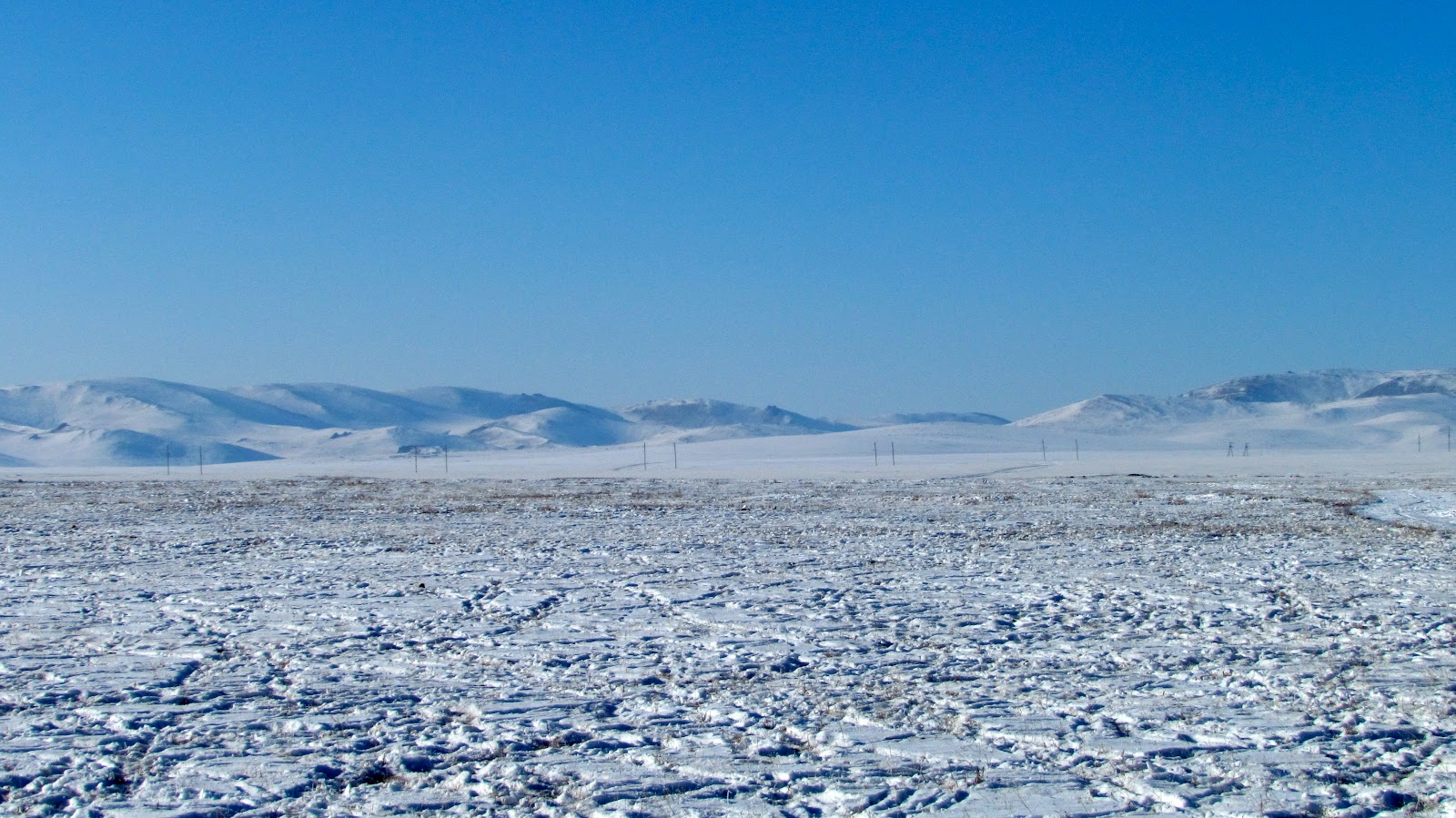
Yesterday, however, was a warmer day (only -10F or so). Since the sun was out, I decided to take a hike out beyond my town’s limits. I was greeted by frozen steppe shadowed by distant mountains. Mongolia is the least densely populated country in the world, a statistic that is immediately remembered upon gazing out into the distance. I thought to myself, If I could climb to the top of that hill, I will see evidence of people on the other side. If I make it to the horizon of the steppe, another town will magically appear. However, I’ve travelled enough to know that many towns, including mine, are hours from the next. In only three minutes, I was beyond my apartment block in utter nothingness. The calm was beautiful.

 |
| The Christmas dog we let thaw inside |
With the onset of winter came Christmas. I went to Ondorkhaan, the aimag center of Khentii Aimag, the province that my town borders. I have several friends who live in the town center, and it was great to spend the holidays with familiar faces. We had a non-traditional Christmas Eve dinner: macaroni and cheese, stuffing, biscuits, and chicken. We made up for the lack of turkey with the array of pies that were present, including pumpkin, apple, and peanut butter. We exchanged white elephant gifts (I gave phone units and received a can of baked beans and a can of mixed vegetables!) and since 3 other volunteers and I bought controllers at the electronics black market in UB when we visited for Thanksgiving, we also were able to play multiplayer Golden Eye 007 (that’s right.) on our computers. Nothing says it’s Christmas like using the cheats to unlock all weapons! Albeit, it was strange to not be fighting my brothers for first player as we did when we were kids. The next day, we celebrated Christmas by eating too much Chinese food a la “A Christmas Story.” Overall, I had a wonderful holiday and am blessed to have such great friends here and such a supportive family back home (whom I got to Skype on Christmas!).
 |
| Christmas Eve dinner! |
I hope that the holidays have found you happy and healthy. Today, I’ll be ringing in the New Year with my sitemates (14 hours before you folks!). Happy New Year! Шинэ жилийн мэнд хүргэe!
 |
| I'll leave you with cows in blankets. Eating the garbage. |
Tuesday, December 20, 2011

Monday, December 5, 2011
"Have you take a medicine?"
For the past several days, I have been sick with a pretty bad cold. It is my second this “winter,” the first being only three weeks ago. Until this point, I had remained very healthy in my new home. But I guess the weather is getting to me.
I’ve avoided going outside, and have been sleeping most of the day. On Saturday, I managed to make a big pot of my granny’s chicken and dumplings, and that lasted me until today. This morning, I called my training manager at school and told her I wouldn’t be coming in. Several hours later, around lunchtime, I heard a knock at my door. Hesitant to answer, I got out of bed and looked through the peephole.
Three of my teachers, Enkhjargal, Bayartsetseg, and Sarantuya, were standing outside. I let them in and was overwhelmed with an onslaught of hospitality. My friends had brought me everything they thought I might need to get better: lemon juice, garlic, vitamin c, chocolate, some horse meat, and soup made from the meat. They poured me some soup immediately, and we talked for a while. They told me what each remedy was for: put the lemon in tea, cook with the garlic, the horse meat will keep you the warmest in winter, melt the chocolate in hot milk before bed. When they discovered that I had just ran out of milk, Bayartsetseg even went back out in the cold to get me some from the store across the playground. When lunch was finished, Sarantuya wanted to leave the rest of the soup with me to have as leftovers, but unfortunately, my only pot was still in the sink from the chicken and dumplings. Enkhjargal quickly began to wash it out, despite my attempt to beat her to it. I was told to go back to bed, and that she was happy to clean my dishes for me. After reminding me to wear my hat and scarf whenever I go outside, they left.
I don’t know what I did as to be so lucky to work with such wonderful people, that even when I cancel class on them, they still come and help me. I can only hope to be as selfless and generous as they are in return.
Friday, December 2, 2011
6 months down...
6 months ago, I left my familiar home for a place I had only read about. I didn’t yet know about the great friends I would make, both with my fellow volunteers and my Mongolian counterparts, the family from the tiniest, isolated town that I would grow to love even through our language barriers, the customs that would become my daily routines, or the weather that would make me redefine any notion of seasons I had ever held. I didn’t know how much I would cherish letters sent from home or the single can of jalapenos that I have been saving, but I knew that I was in for an adventure.
Despite living alone, I have been cared for by many people. Through the magic of the internet, I am able to call home often. When I have a problem, my counterparts are quick to my rescue. With my first cold of the winter arrived teachers to my home, bringing tea and chocolates, giving me remedies for my illness. I feel compassion from the members of my community with whom I interact. It is shown in my store lady’s concern: “Make sure to dress warm. It’s good that you live close.” It’s in the students who follow me to and from school yelling, “Bagshaa!” reminding me of my role as their teacher, and it’s in the ones who scribble down lyrics to Mongolian pop songs for me, reminding me of my role as their friend.
I am thankful for my past 6 months in Mongolia, for my friends and family back home, and for the ones that I have made in-country. Happy (belated) Thanksgiving to you all!
Tuesday, November 8, 2011
End of First Quarter: Struggles and Successes
We have reached the end of the first quarter of classes. Next week, I’ll have fall break to relax and celebrate surviving 9 weeks in the Mongolian school system. To commemorate, I thought I’d archive some of my struggles and successes.
—Struggles—
Class size: My 9th grade class has 39 students. My fifth grade, 42. These are my largest classes (which I solo teach) and classroom management is extremely tiresome. Logistically, I just do not have enough resources to keep my 3 ½ dozen students occupied at all times with out someone getting off task. Group work, while ideal, is nearly ineffective, because since the groups are so numerous, it makes assessment practically impossible. Therefore, I am left without knowing whether my students comprehended the material or not.
Material: I do not work from books in any of my classes, so I am the sole opinion on what curriculum we should cover. Sounds great in theory: I can teach what I want, when I want. But I want to be preparing my students to meet whatever goal they have for learning English. And since this is my first time teaching English as a foreign language, I do not always know what is the most helpful way to learn what I am realizing to be a very intricate and complicated language.
Resources: Teachers have to supply their own resources—paper, chalk, markers, anything you might need to use in class. Having a very small living budget and class sizes that make creating effective resources the biggest challenge ever, I constantly have to decide whether or not a certain visual or manipulative is really vital to whatever lesson I’m teaching. Plus, I’m running out of single-sided handouts from Pre-Service Training that I’ve been recycling by printing on the other side.
Weather: It’s getting cold.
That got pretty lengthy. Nothing is terrible.
—Successes—
Clubs: I have started two clubs at school, a drama club for students in 7th-9th grades, and a song and poem club for students in 4th-5th grades. These have easily become my favorite classes and the highlight of my week. My class size is small—less than 25 students, and I get to teach whatever I want (I realize this sounds like my previously listed struggle, but in this context it is wonderful). The idea is that these are English clubs, but we are practicing our skills through drama and poetry. I get to revive games and warm-ups from my repertoire that I used to play back in my theatre days, and I get to incorporate fun songs for my little kids complete with hand motions and everything. Also, I get to teach these two classes in our school’s “art room,” which is like a dance room with mirrors and a stage. I use the mirrors to write down dialogue or song lyrics with a marker, and my kids eagerly circle around to see what we’ll be learning next. I just broke up my drama kids into pairs for their first scene, and they have been adorable with it. My song kids know “If you’re happy and you know it” and “The Moose Song.” It is fun to be out of desks for the hour.
Phone Calls from Eej: Weekly, I talk on the phone with my host mom from Orkhon. I get a chance to practice my Mongolian and get caught up on life back in my soum. Recently, she told me that one of our hashaa dogs, Mojgai, had 3 puppies. Other newsworthy information: the cows were fine, the river was freezing over, my siblings will come home soon, and my host dad was sleeping in the other room. Eej always asks if I’m warm and eating food. I tell her I am both. I tell her that I may visit in February for Tsaagan Sar, and that би танд дандаа сандаг—I miss you always.
Cooking: I didn’t lie to Eej; I am eating. In fact, I really enjoy cooking here with what I can find. I have only one burner and one pan, but I make due. Last month, I bought a rice cooker, and it gets the job done. I need to figure out what I’m going to make to bring to Thanksgiving in UB.
Traveling: Last weekend, I successfully traveled to UB alone. As in, I navigated the insanity that is transportation in Mongolia, and arrived safely where I should have, and then made it back to the bus station, bought a ticket, and made it home. This was my first trip back to the capital since being there one night after Swearing-In in August, and it was my first time exploring the city. Cheesburgers! Bacon! Escalators! I’ll be back in a couple of weeks, more confident in my abilities to take a trip there when I need to.
With a quarter of the school year complete, I’m still at times shocked to remember that I’m living in Mongolia. Life is feeling routine. Both the struggles and the successes I have here are just a part of my normal daily life. Here’s to fall break!
Thursday, November 3, 2011
October Happenings
As October has left, so have the leaves on the few trees lining the streets of Baganuur. Now, ice covers the sidewalks where children slide to school. I have been busy this month. For a week, I went to daily acupuncture sessions at the hospital in hopes of quelling the migraines that plague me. After following the smell of tea, I arrived in the alternative medicine wing where my doctor manipulated ten small needles in various pressure points. Then, small cups were suctioned to my back with a hand pump and moved around to increase circulation in a practice fittingly called cupping. I was also told to not touch cold things. Good to know. No word on the effectiveness yet, but the sessions let me get some relaxation, at least.
 |
| A poster my 9th grader drew: Alcohol as a Magnet |
October was also the proud parent of Alcohol Awareness Week—a nation-wide outreach project to educate the population on the risks that can accompany the country’s dangerous affair with overconsumption. The theme of this year’s campaign was “peer pressure,” aptly chosen, considering the cultural customs that surround drinking here make it very difficult to turn down alcohol when it’s offered, as doing so can be viewed as offensive. I’m also highly suspicious that there is an old wives’ tale that Mongolian vodka has a one-hour shelf life—that it will go bad if you do not finish the bottle once you open it. Or so people seem to believe. For this year’s activities, my sitemates and I involved our police department, our children’s center, and even our governor’s office. We held a competition between the two main school complexes in my town.
 |
| The Man Who Wanted to be as Strong as a Wolf |
 |
| Fetal Alcohol Syndrome |
Each school selected winning posters from 9th grade that fit the theme, a winning AXA (ah ha) team from 10th grade, and two winning ACK (ask) teams from 11th grade to compete against the winners from the other school complex. Enter note on Mongolian competitive nature: Mongolians are competitive. A few weeks ago, my teachers drafted me to play in a volleyball tournament that started at 7 pm on a Tuesday night. Our team took first place and the 100,000,000 Tugrik prize around 12:30 in the morning. However, the tournament victory was not enough, because it was at this point when we started playing side games for funsies. On a school night. After over 5 hours. C’mon. Anyway, we knew the kids would be all for the competition. We held the event at our town’s culture center, and it started only an hour after it was supposed to. Not too bad. AXA is a game show-type activity where students have to answer questions on stage and if they get one wrong, they have to remove one of three sticky stars they have placed on their chests (humiliating for a Mongolian who prides awards and recognition of success, trust me, but they adore AXA).
 |
| All of the ACK teams |
 |
| An ACK skit |
 |
| pizza! |
 |
| okonomiyaki! |


 After we wrapped up Alcohol Awareness Week, we threw a Halloween party for our friends here who are other volunteers from Japan and Korea, as well as a few co-workers. Our party was their first interaction with Halloween, so we did our best to make it authentic. We told them to come in costume, and they did a great job. I fashioned a robot get-up from old care packages that was stellar at masking my lack of creativity when it came to dance moves. We made pizza and our Japanese friends brought an assortment of their own delicacies. We had candy and drinks and even a pie. We made good use of the spigot half of one of our water filters to make a punch bowl for “pink drink” (too reminiscent of Pepto-Bismol for comfort) and kept everything else cold in our bathing tumpins using snow we gathered outside (genius). We had a very successful night indeed.
Now as October has wrapped up, I realize that I have been in Mongolia for 5 months. Moreover, I have almost been at my permanent site longer than I was at my training site, a new milestone in itself. Each day, the time I spent in Orkhon learning Mongolian, growing to love my host family, herding cows, making friends, climbing mountains, swimming in the river, and soaking up the sun feel more distant, especially as a permanent cloud of grey swallows the impending winter sky. Still, I have fond memories of the days in the heat, and after each phone call with my host mom, I daydream of returning to visit.
Tuesday, October 11, 2011
Counting My Blessings
It has been over 4 months since I moved to Mongolia, and life feels normal. Still, every now and then, like yesterday when walking home from the shady, underground market after finding celery (celery!) as the sun was setting and the cool night air was claiming the ground, I become consumed by a feeling of overwhelming fortune. How fortunate am I to have the experience to share myself with people across the world, and in return be taught so much about different ways of life? I am calling the most sparsely populated country in the world my home and the people I meet here my friends. It is baffling, a word that I recently taught my teachers to describe the pronunciation rules in the English language, but that completely applies to my incapability to fully explain how it feels to be here each day.
As if that wasn't enough, my friends and family have found ways to shower me with love and thoughts though I'm an ocean away. I have received care packages from my mom, my best friend, and my uncle, aunt, and grandmother. I feel so special when I receive them, knowing they put so much thought into sending it. I like imagining picking up things at the store, thinking, surely Sara needs this, then laying out the contents on their kitchen table, on their apartment floor, and trying to maneuver a way for it all to fit. And though these are just things, the reception of them is no less significant. Not to mention, I have discovered a list of things it only takes 4 months to start missing. Included: peanut butter m&ms, popcorn, hot sauce, cinnamon, trail mix, velveeta, and of course, the unfortunately unshippable avocado. I can now actually cook more than plain rice for every meal. I can make things spicy! I can have a snack between meals that doesn't consist of боов (pastry-type bread). I can fashion a movie night complete with candy from home. I can color pictures in preparation for the holidays. I hope that these things don't sound too mundane, because they really have meant so much to me, and I cannot thank my gracious senders enough for the time, effort, thought, and money that went in to sending these treasures my way.
In end, I guess you could say that getting amazing care packages has made my Mongolian life cushier. Still, I am still incredibly thankful to be able to emerge from the shady, underground vegetable and meat market with newly purchased celery feeling inspired and comforted by the breeze that greets me.
As if that wasn't enough, my friends and family have found ways to shower me with love and thoughts though I'm an ocean away. I have received care packages from my mom, my best friend, and my uncle, aunt, and grandmother. I feel so special when I receive them, knowing they put so much thought into sending it. I like imagining picking up things at the store, thinking, surely Sara needs this, then laying out the contents on their kitchen table, on their apartment floor, and trying to maneuver a way for it all to fit. And though these are just things, the reception of them is no less significant. Not to mention, I have discovered a list of things it only takes 4 months to start missing. Included: peanut butter m&ms, popcorn, hot sauce, cinnamon, trail mix, velveeta, and of course, the unfortunately unshippable avocado. I can now actually cook more than plain rice for every meal. I can make things spicy! I can have a snack between meals that doesn't consist of боов (pastry-type bread). I can fashion a movie night complete with candy from home. I can color pictures in preparation for the holidays. I hope that these things don't sound too mundane, because they really have meant so much to me, and I cannot thank my gracious senders enough for the time, effort, thought, and money that went in to sending these treasures my way.
In end, I guess you could say that getting amazing care packages has made my Mongolian life cushier. Still, I am still incredibly thankful to be able to emerge from the shady, underground vegetable and meat market with newly purchased celery feeling inspired and comforted by the breeze that greets me.
Subscribe to:
Posts (Atom)